Cross-Country Skiing in Banff – Don’t Freeze the Insulin!
I really like to cross-country ski, I’ve loved it since I was a kid. I actually like to cross-country ski more than I like to downhill ski. Sadly don’t get to go that often, but a few years ago I was able to go! And it was beautiful! There are a few things to be aware of before a type 1 diabetic goes cross-country skiing alone. 1. Inform someone where you are going and how long you will be gone, 2. Make sure your insulin doesn’t freeze, 3. Carry enough glucose in case you go low, and 4. Make sure you also carry your glucose meter and/or CGM receiver (usually your phone).
Inform someone where you are going
Since I was traveling alone during this trip, I would tell multiple people where I was going and what trail I was on. If I was in town or at a popular destination that didn’t involve hiking, skiing, or another activity on a trail away from people and a road, I wouldn’t always tell my friends and family where I was. Only because in these locations I always had cell service and/or wifi and could easily contact someone via phone or in person for help.
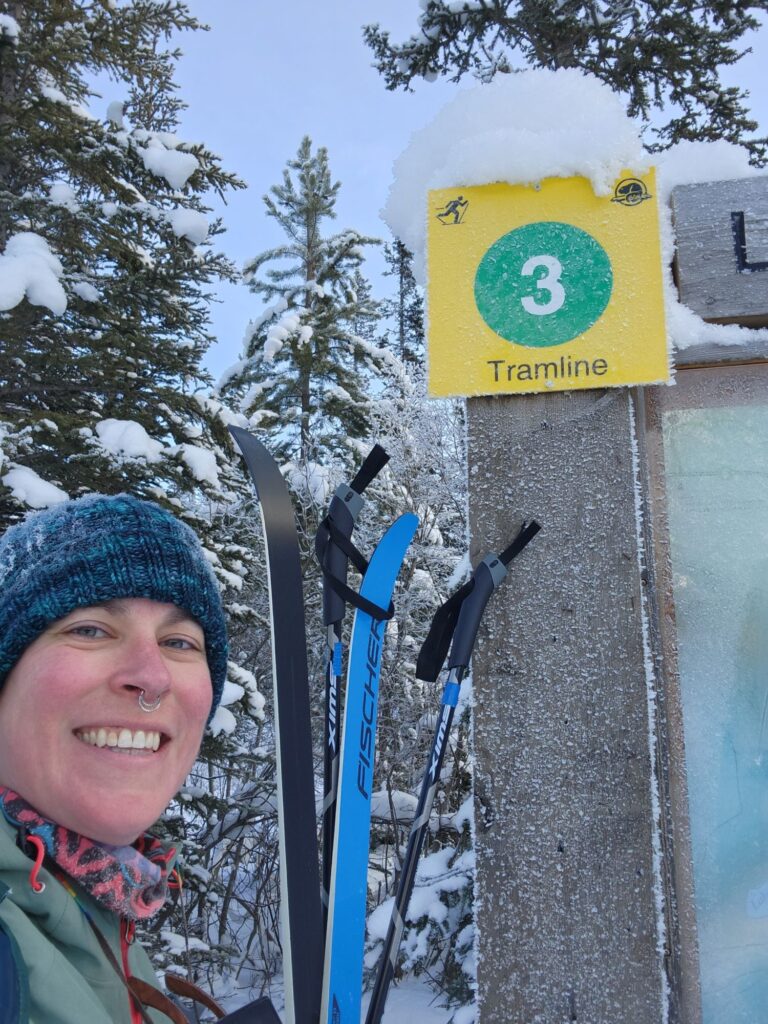
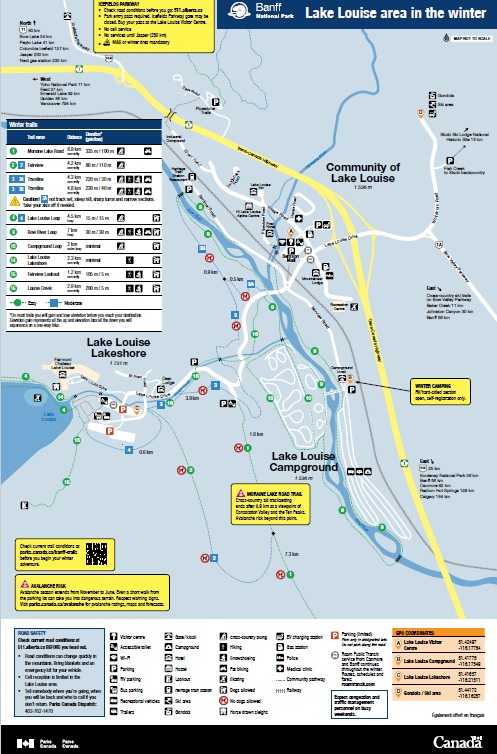
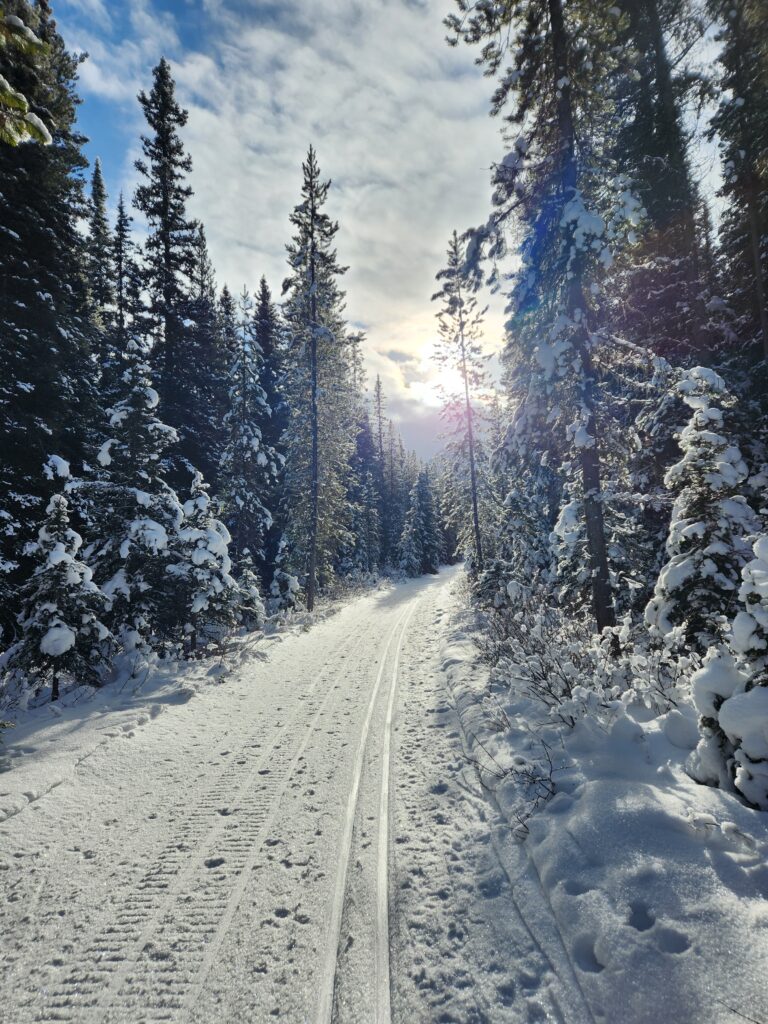
For cross-country skiing I definitely told my friends and family where I was going and what trail I was going to ski. I also told the ski rental company in town where I was going and when I would return the skis. (Thanks to a giant blister that formed on my heel from the ski boots I only went on one trail). The trail I skied was in Lake Louise, called the Tramline. Although there might not be a lot of people on the trail, there was a large lodge nearby. This was helpful in case something did happen and I needed assistance. I also carried my Garmin InReach with me. This way I had all sorts of protection and multiple backups.
Make sure your insulin doesn’t freeze
According to the Diabetes Disaster Response Coalition you should not let your insulin freeze and if it does, do not use it! “Do not use insulin that has been frozen.” (Yes, that line in their document is in fact bolded for emphasis.) Insulin should not be in extreme temperatures (anything below 36 °F/2 °C or above 86 °F/30 °C). If it’s exposed to extreme temperatures, the shorter the amount of time the better. The longer insulin is in extreme temperatures, the less effective the insulin becomes.
As you can imagine, when you’re cross-country skiing there is usually snow on the ground. And it tends to be below freezing when there is snow on the ground. When I’m outside in freezing weather, for longer than just walking from my car to an inside place, I put my insulin as close to my body as possible. Luckily on all of the snow jackets I’ve had, they have had nice sized inside pockets. This is where I put my insulin. I also periodically check to make sure my insulin isn’t getting too cold. And since I am doing physical activity, my body heats up and stays hot, which is good to make sure my insulin doesn’t get too cold. Thank you exercise! (I am a sweaty person. It’s sooooo much fun…..)
Carry enough glucose
Every type 1 diabetic needs to carry some sort of glucose with them at all times. I have also mentioned this in my Packing List post. Where I am going will determine what type/s of glucose I pack. For this particular excursion I packed glucose tablets, a couple granola bars, and a couple packs of gummies. These are small in size and weight, and I can easily pack them in all of my jacket pockets. (I’m so glad that women’s snow jackets have inside pockets! I love inside pockets!)
When type 1 diabetics do physical activity, they’re at a greater risk for their blood sugar number to drop. Cross-country skiing is a physical activity, so I expected my blood sugar to go down at some point (spoiler: it did).
Carry your glucose meter or CGM
Just like number 3, every type 1 diabetic needs to carry their glucose meter or the CGM with them at all times. I would say this is more important to carry than glucose. At the time of this trip, I was using a Dexcom G7 CGM and I was using the Dexcom app on my phone to view all of my glucose readings. Like all other CGMs (that I know of) there are alarms in place to notify you if you are too high, too low, etc. This is great when you are doing something else and not staring at your phone, like I was doing while exercising. It wasn’t the easiest to pull out my phone and view my screen while wearing large snow gloves. Knowing that I would hear an alarm while skiing was comforting.
Unlucky for me, my CGM wasn’t working very well during the second half of my time out in the freezing, snowy weather. As you are not supposed to leave your insulin out in extreme temperatures, it is not good for your CGM either. I already knew this, as it’s happened to me before, so I was aware and ready. Read more in my Comparing CGMs post. I did find this a bit strange as my insulin never got too cold, but my CGM did and they were both reaping the benefit of my body heat.
Going Low While Cross-Country Skiing
On my way back from the turnaround point, I started sweating A LOT. At first, I thought “oh that makes sense I have been skiing on a slight uphill for awhile and cross-country skiing takes a lot of work”. But then I realized “… oh wait, I’m probably low.” I was near a section that crossed a road so it was a great place to stop, in case I needed some help. I stopped skiing, took off my gloves, and checked my CGM. It said I was above 200, which I knew was incorrect. I, being the prepared diabetic that I am, pulled out my glucose meter to double check. This told me that I was below 50….. this made more sense to the feelings and symptoms I was having.
I plopped down on the side of the trail and got out some glucose tablets and a granola bar. I sat there, probably looking defeated, confused, and in need of assistance. There was a group of 4 other skiers that came by and asked why I was sitting in the snow. I told them that my blood sugar was low. That I had taken the proper amount of glucose and was waiting for my number to go back up. That I’ll be fine, I just had to wait. And no they didn’t need to wait with me until that happened.
While I was sitting there waiting for my number to go up, my CGM readings did start to go down. It seemed by the time I was ready to start skiing again, my CGM had almost caught up to what my glucose meter was reading. I took some gummies for good measure, and finished the trail without any more diabetic issues.
You Can do it Too!
As a type 1 diabetic, being in a different country, in freezing temperatures, doing a lot of physical activity, alone can be scary. But that doesn’t mean you can’t travel and have a good time. You just need to do some extra planning and take all of the precautions. I was nervous to travel on my own the first few times, but starting small, organizing, and making lists really helped get me to where I am now. Type 1 diabetes doesn’t have to hold you back.