
Packing List for a Traveling Type 1 Diabetic
I’m sharing my diabetic supplies packing list below. It includes a general packing list and then I add items if I am traveling to a place that is very hot or very cold. This is my personal packing list that I use with my prescriptions and supplies that have worked for me. Your prescriptions might be different than mine and the supplies that you and your doctor agree on might be different, and that is just fine. Use what is best for you.
I love lists, to-do lists, reading lists, grocery lists, bucket lists, and packing lists. I became an expert in packing lists in particular for work travel. Packing lists for sea are always something I shared with new employees and volunteers. No one wants to forget anything when they’re away for at least a week.
I usually put this at the end of my posts, but please read my disclaimer, and talk to a medical professional if you have any questions or concerns.
Just like I said in my “9 Travel Tips for a Type 1 Diabetic” post, I hope this can help those of you who want to travel, want to travel more and haven’t for whatever reason. Just because you have type 1 diabetes or any other disability or illness doesn’t mean the world is shut off to you. There may be extra steps and planning involved, but you don’t have to let that stop you!
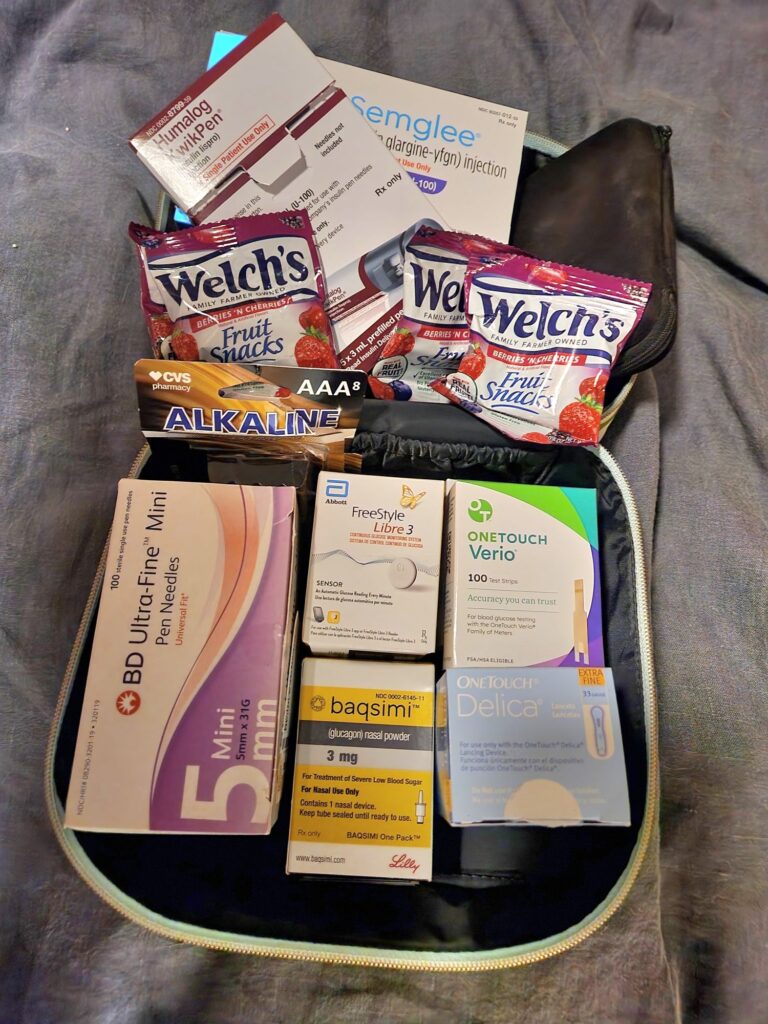
General Packing List:
- Fingerstick
- Spare batteries for fingerstick
- Test strips
- Lancets
- Continuous Glucose Monitor
- Insulin pens – long acting
- Insulin pens – fast acting
- Pen needles
- Alcohol wipes
- Sharps container
- Glucose tablets
- Granola bars/protein bars
- Juice
- Prescription documentation
- Glucagon nasal powder
- Medical ID necklace
Added Items for Hot Weather:
- Cooler pack
- Ice packs
I have traveled to a few places that are very hot. Insulin is not meant to be in hot temperatures. The CDC says “Insulin products contained in vials or cartridges supplied by the manufacturers (opened or unopened) may be left unrefrigerated at a temperature between 59°F and 86°F for up to 28 days and continue to work. However, an insulin product that has been altered for the purpose of dilution or by removal from the manufacturer’s original vial should be discarded within two weeks.”
When you are in a place where temperatures get above and stay above 86°F you need to keep your insulin in a cooler or refrigerator. There are small soft coolers that you can keep your insulin in when you are out and about.
I try to avoid prolonged time outdoors in this kind of heat. When I am inside, I put my insulin in a refrigerator or in a cooler with ice packs that is out of the sun. Not every hotel will have mini fridges in each room. If this is the case you can ask the hotel staff to put your insulin in their refrigerator and pick it up when you leave.

Insulin Stored in Hotel Refrigerator
This happened to me when I went to France in 2006 with my high school French class. The first hotel we went to did not have room mini fridges. So, I asked the staff… well my French teacher who actually knows the language asked the staff if they could store my insulin in the staff fridge. It worked out great. This was until we were leaving this hotel and taking a bus to our next city. I’m on the tour bus driving away from the hotel and it hits me, I forgot to get my insulin from the hotel staff.
Logically I knew I needed my insulin and I had to stop the bus, but emotionally I didn’t want to delay our trip. I was in the process of convincing myself that I was being a burden. I was so worried that this would make everyone else mad, that because of my disease it would delay and therefore ruin our trip. Now, I know that having to stop to get a lifesaving medicine isn’t ruining anything.
After a couple of minutes, I finally got up and walked to the front of the bus and told my teacher and the driver that we had to stop. Awkwardly avoiding eye contact, I told everyone that we had to stop so I could go back and get my insulin. My teacher and I got a cab and drove back to the hotel. She stayed in the cab so it would wait for us, while I ran up and got my insulin back.
When I got to the desk, I realized that my French speaking skills were not good. The words “insulin” and “prescription” aren’t words that you learn in a high school language class. Because I was freaking out and I didn’t have time to overthink anything I was able to come up with a few French words that got my point across. I also tried miming injecting insulin.
When we got back to the bus everyone was actually very happy for me. This showed me that I did not ruin anything by having to go back. I haven’t forgotten my insulin in a hotel again.
Added items for Cold Weather:
- Insulated bag
- Money or anti-theft type bag
- Hand warmers
As you already read in the Hot Weather section, insulin should not get below 59°F. In general, you should keep insulin as cool as possible. You need to keep it cool, but not too cold and definitely don’t let it freeze. The CDC says “If you are using ice, avoid freezing the insulin. Do not use insulin that has been frozen.”
When you’re in a place with snow and ice, you need to take precautions to ensure your insulin does not freeze. There are a few ways I’ve done this over the years. The most common way I do this is keeping my insulin in an internal pocket or bag that sits right against my body. This uses my body heat to keep the insulin from freezing.
Another way I have prevented my insulin from freezing is using hand warmers. I usually only do this when I am camping and it gets cold at night. I will keep the insulin inside the sleeping bag with me and use hand warmers. You do have to be careful not to fall asleep with the hand warmers inside the sleeping bag as this is dangerous. Please read and adhere to all safety warnings on the hand warmer packaging.
Not only can insulin freeze and stop working, but your fingerstick can get too cold to work as well. In addition to my insulin, I will keep my fingerstick in an internal pocket to take advantage of my body heat.

Turning Around Early When It Gets Too Cold
I went on a spring time solo trip to the Eastern Sierras to hike the Big Pine Lakes trail. At the time, springtime was a good time to go, it’s early enough to avoid the large summer crowds, and it’s late enough to avoid the snow.
The weather changed last minute and was going to be much colder than last week’s forecast. This last-minute weather change also predicted a high chance of snow during my hike. I am no stranger to cold and actually prefer being in cooler temperatures than warmer ones. I called some friends and family to notify them the change in the weather and that I was still going to attempt the hike.
The day of the hike I packed up all of my diabetic gear, safety gear, and enough water. The first part of the hike was beautiful, no snow, no ice, and stunning. Once I reached high elevation, the trail was covered in at least a foot of snow. This is not what I was ready for.
I continued on for a half of a mile, when I stopped to check my blood sugar number. My fingerstick was too cold to work. I immediately put my fingerstick in an inside pocket where my insulin was and turned around.
Unfortunately, I didn’t even make it a quarter of the way into the hike before I was forced to turn around. I wasn’t upset about this though; my life and safety are more important than finishing a hike. After I got out of the snow, my fingerstick warmed up. I was able to successfully check my blood sugar number again. I made my way back to my car and went into town and found something else fun to do.
4 Comments