Scuba Diving and Diabetes – A Brief History
“We certainly concur with the [authors] that “if a hypoglycemic episode occurs underwater or away from shore, the results could be incapacitating and tragic.” However, this same warning applies to almost any activity in which the insulin-dependent diabetic chooses to participate (eg, driving a car). It would be unfair to disallow those responsible adolescents to participate in an activity they choose without some individualization.”
That’s a quote from an article from 1987. (I wouldn’t pay for full access to the article, but I still think it’s a very good quote from the abstract!) I completely agree with this quote. Just like with most things in life for a diabetic, there is always a risk. But if you’re careful and prepared, each risk, including scuba diving, is lessened.
I Love the Ocean
I don’t remember when exactly it happened but I love and have always loved the ocean, and everything in it. I wanted to know all of the plants and animals that live there, how many there were, and how they grow. Trips to the beach were my favorite. Large lakes and rivers were my second choice. As a child one of my camp nicknames was “Fish” because I would always stay in the water past the time we had to get out.
Because of this I always knew that I would go scuba diving one day. Luckily when I was ready to take a scuba class, I was able to. I just had to get my doctor’s approval (which I did!). Thanks to my field of study, marine biology, and taking good care of my diabetes, my doctor signed off. Open water scuba class, here I come! I took this class when I was in college in 2008, and it lead to many more scuba classes and diving.
Time for Scuba Class
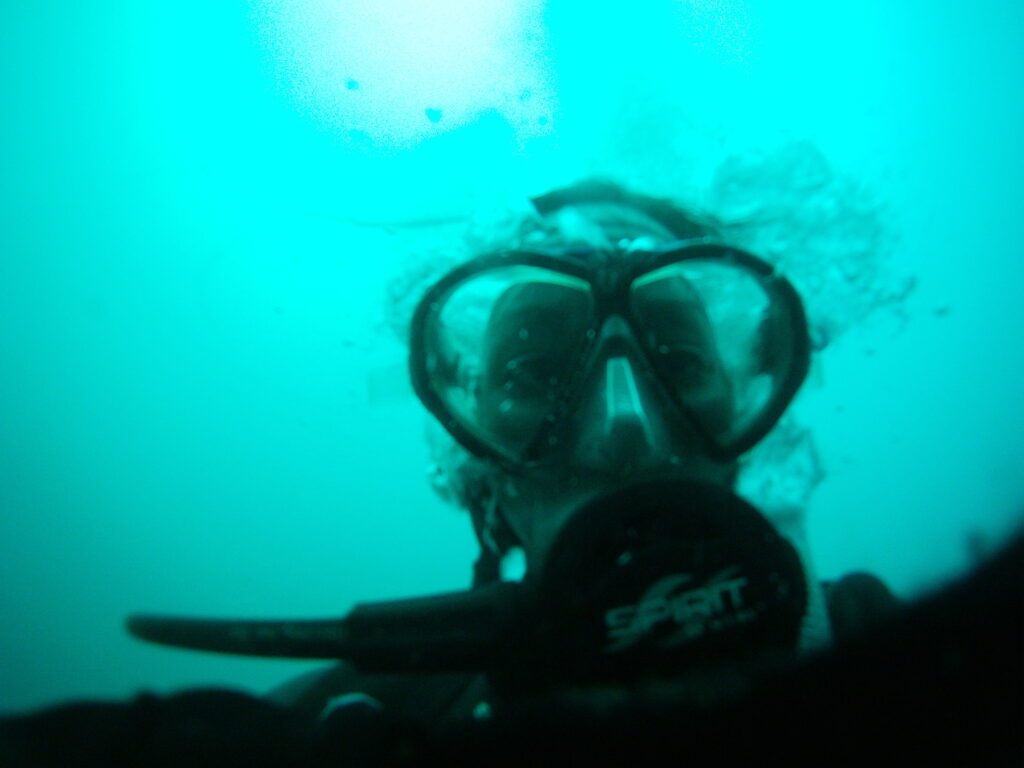
Before starting my class, I made sure to ask my doctor questions and follow their guidelines. I informed the dive instructor that I have diabetes. I also shared with all of my fellow classmates that I have diabetes and what to be aware of. The class went well and I never had any issues regarding my diabetes during or since taking the class. (But I did realize that I need to get some more photos of me scuba diving.)
For those of you with type 1 diabetes who want to go scuba diving there are a few resources you can turn to for guidance. No matter how many websites and scuba organizations you talk to, you always need to speak to your doctor about it before you go for the first time. Read my disclaimer.
A Brief History
Type 1 diabetes and scuba diving did not always get along. In 2001 the Diving & Hyperbaric Medicine Journal published a study that recommended “Diabetes requiring medication with insulin is a contra-indication for diving.” And they were definitely not the only ones who didn’t want diabetics to scuba dive.
While some studies on diabetic divers began in 1996, it wouldn’t be until the early- to mid-2000s when countries and diving organizations would allow diabetics to dive. As long as they followed specific safety guidelines.
Prior to the 2000s it was not allowed/strongly discouraged for diabetics to scuba dive. But that didn’t mean that all diabetics followed these rules. In 1996 Divers Alert Network (DAN) published an anonymous voluntary survey of its members (link below), and found that nearly 200 of their scuba divers had some kind of diabetes. (I could not find out exactly how many total members DAN had at this time.)
Rules & Conclusions from 1996 Study:
This study demonstrated that insulin dependent diabetics can scuba dive safely. As long as the diabetic has stable blood glucose during training and experience under non-diabetic “buddy-control” is given. Even though this study was performed in 1996, it still took nine years until it was considered “allowed”.
The following were the guidelines this study came up with:
- No scuba diving with manifestations of the complications of diabetes (retinopathies, polyneuropathies, nephropathies etc.)
- Limited diving certifications (one year), with renewal based on diving medical and study of the diabetic dive log
- At least one non-diabetic buddy with sufficient knowledge of emergency procedures (blood glucose measurement and glucose administration)
- Emergency glucose rations and glucagon in water-tight container in the BCD
- At least three blood glucose tests before the dive (60 minutes before, 30 minutes before and just before the dive) and another immediately after the dive.
- A blood glucose level over 160 mg/dl before every dive
- Depth limited to 30 m
- Use a diabetic dive log to accumulate “reference” data for similar dives
- Sufficient hydration (a min of 2 l before the first dive but no more than 1 1/hour).
- Late testing (12-15 hours) after the dive to detect and prevent hypoglycemia due to muscle-storage repletion
- Oxygen and emergency equipment at the dive site
General Timeline of Decisions and Studies Regarding Scuba Diving with Diabetes
After some research I was able to create a general timeline for diabetics scuba diving. It includes prominent studies with diabetics diving, decision changes, and when different countries and diver organizations made these changes. It is interesting that with all of the same data available different countries “allowed” diabetics to scuba dive at different times.
For a larger version of the timeline shown below, download the PDF

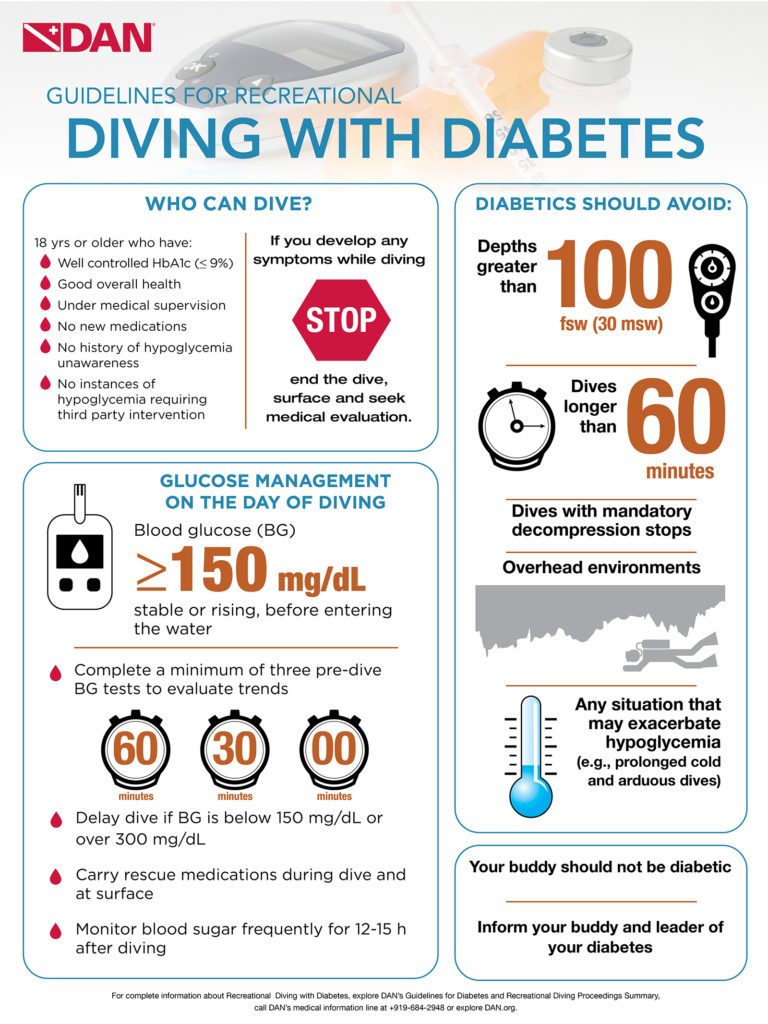
Currant Australian and USA Infographic for Diving with Diabetes
Today, every country and diver organization that I found allows and supports diabetics going scuba diving. As long as they do so safely and follow certain guidelines.
I found these two infographics, one from Australia and one from the US. They have a lot of the same information, but have some slight differences. Look through them and find where they say the same thing and where they have some subtle differences.

My Closing Thoughts
I learned early on that there were things that diabetics shouldn’t do, or if you have to (or really really want to) do it, you have to be extra careful. I am glad that today, diabetics can scuba dive without added fear and negativity from others. Scuba diving by itself comes with a lot of extra dangers. The added precautions diabetics take when scuba diving are easy and obvious ones, at least in my opinion.
Luckily for me, I have been following some of these scuba diving guidelines without knowing that they were actual guidelines. A lot of them are just things that make sense to me, that you would do without anyone having to tell you. The rule they have about the frequency of checking your blood sugar number before and after diving, is just so obvious to me. I can’t see any diabetic not doing this as a baseline regardless of the official guidelines.
Diabetes, like a lot of things, can add unwanted complications to your life. Even with added complications, there are still ways to live and experience life the way you want. Not everyone wants to go scuba diving, but if you want to, there is a safe way to do so!
More References
If you’re curious, here are some more articles on the topic.
Recreational diving in persons with type 1 and type 2 diabetes: Advancing capabilities and recommendations – published in 2020
Diabetes and diving: where to now for SPUMS? – published in 2006
Safety of recreational scuba diving in type 1 diabetic patients: The Deep Monitoring programme – published in 2009
Diabetes as a contraindication to diving: Should old dogma give way to new evidence? – published in 2001
Into the deep blue sea: A review of the safety of recreational diving in people with diabetes mellitus PDF – published in 2019





One Comment