Scuba Diving for Work with Diabetes
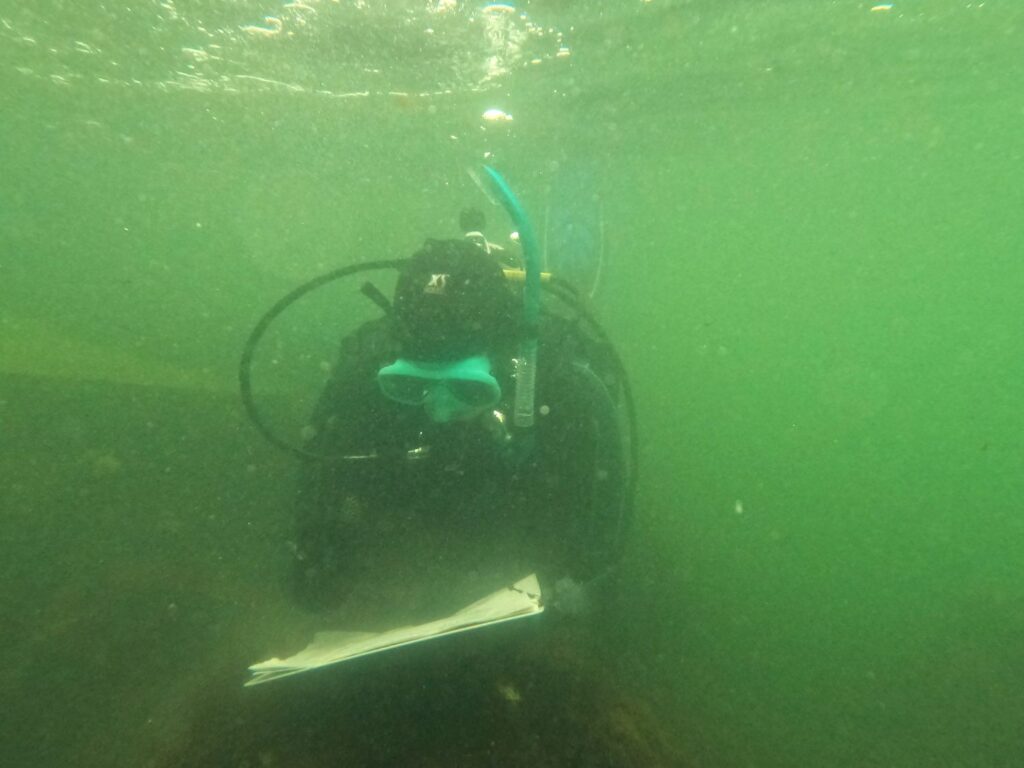
Just a few meters underwater I’m scribbling down barley legible numbers on waterproof paper with a blunt pencil. “Oh wait, was it 11 or 12 oysters?” I think to myself. Ugh, I’ll have to count them again. As I’m re-counting, I see my coworker scuba over to the next structure to take hi-resolution photographs of all of the marine invertebrates living on the substrate.
Scuba Diving for my Job
I’m lucky enough to have a job that requires that I go scuba diving sometimes. I know it’s so horrible (just kidding, it’s awesome). Work dives are less fun than personal dives though. My work dives require carrying a clipboard with data sheets, recording data while underwater, all while wearing thick gloves. There’s a lot less swimming around looking at and only admiring marine creatures, which is what I do in my fun dives.
This project in particular involved scuba diving approximately one to two meters below the surface to document all of the organisms living on fancy concrete structures. These structures are supposed to help boost biodiversity along the shoreline. This isn’t a compressive list, but includes some of the animals I would see during these work dives.

My Diabetes and Scuba Diving
When I first started working on this project, I’d been scuba diving for over 15 years and am comfortable with scuba diving and don’t have any diabetic fears. One of the good things about this is in the off chance something did happen, we are shallow and staying right next to shoreline in a public place. There’s always people walking around who could help if needed.
Just like with every dive, work or personal, you need a dive buddy. My coworker was my buddy and he knew about my diabetes and was always ready to help if needed. One of the ways he helped me was carrying a glucose gel in the pocket of his wetsuit. (Yes, he has a pocket in his wetsuit. I was and still am jealous!)
No Diabetes Issues While Diving
I am happy to report that diabetes was never an issue during any of these dives. I always unknowingly followed the dive rules for diabetes. You can find those rules in my Scuba Diving and Diabetes – a Brief History post. I would also pack a small waterproof bag with my fingerstick and glucose of some kind (tablets, gummies, granola bars, etc.) that I left on the rocks near where we entered and exited the water. This way I could immediately check myself when getting out of the water, and had easy access to more glucose if needed.
Other Issues Did Arise
There were some other issues that happened during these dives that had nothing to do with diabetes. Don’t worry I’ll tell you about them.
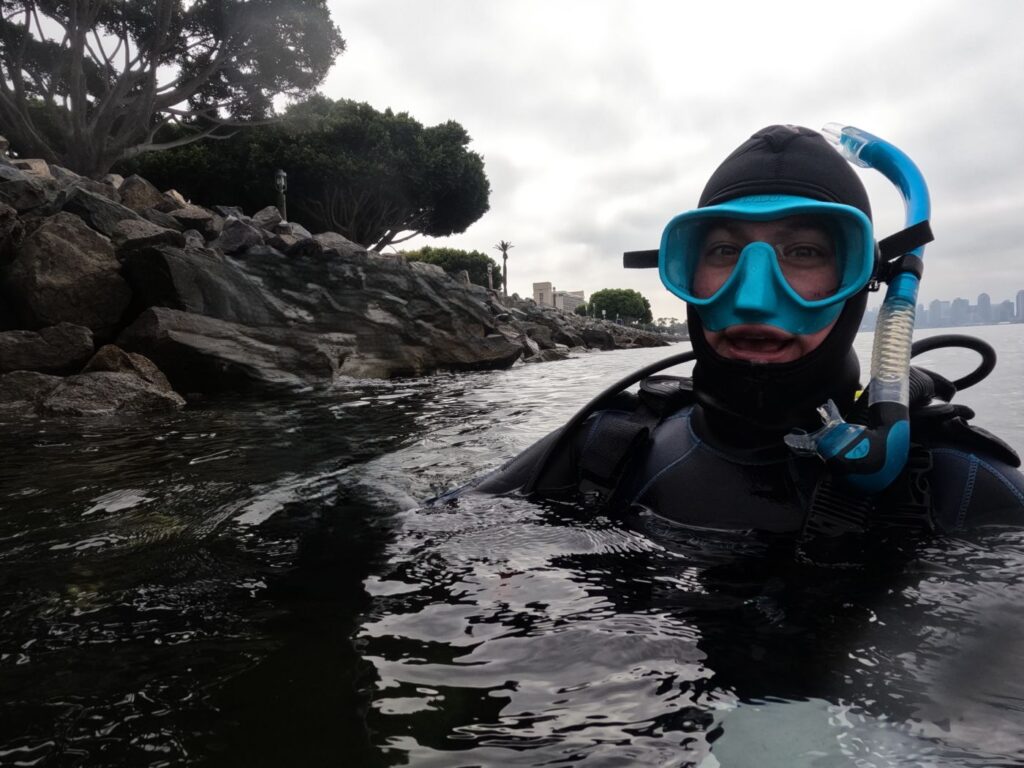
One of the issues that happened during every dive was having to walk up and down riprap wearing full scuba gear. Riprap is a layer of large stones that run along some shorelines (seen in the photo above). It’s easy enough to walk on when you aren’t carrying anything and can use your hands as a third or fourth point of contact. But traversing layers of large rocks as you walk down to the waterline in full scuba gear is challenging.
If you’ve never scuba dove before, walking around on flat open ground, with everything on is heavy and you get tired quickly. Walking up and down stairs is its own challenge in full gear. You have a large metal tank, and 10s of pounds of additional weight on your waist/vest/ankles, all while wearing a constricting wetsuit, hood, and gloves. (Sometimes you wear thinner wetsuits, it just depends on where you’re diving and how warm the water is. Where I was diving it was cold and I needed a thick wetsuit.)
Limited Dexterity Underwater
Another challenge is having to write on waterproof paper underwater on a clip board. It isn’t easy to write legibly. Everyone has their preference of type of waterproof paper and pencil that they like to use, and it took me some time for me to find the right pencil for the job. One of the most challenging things was having to bring down at least 10 data sheets and switching data sheets out underwater without loosing any of them. This was a slow and steady wins the race type of activity.
Luckily, I do have some (not much) dexterity with my scuba gloves and never lost any data sheets. But I never enjoyed doing it.
Dive Equipment Failure
The last issue we had lead to us postponing the dive to the next day. There was a problem with both me and my dive buddy’s dive gear. My dive buddy uses a weight belt, which means you secure a thick belt with weights attached around your waist. One of the pieces of the belt that keep it on your waist had broken off and no matter how many zipties we used, we could not get his belt to stay on.
While in the water testing out our weight belt ziptie option, I realized that by dive vest (BCD) was leaking air and wouldn’t keep any air in the vest. Both of these issues resulted in both of us not being able to dive safely (or at all). So, I called it, we were not diving that day. We each took the rest of the morning to get our gear checked out and fixed, then came back the next morning to complete the dive, safely.
Sometimes when things go wrong you have to stop and reassess the situation. Whether it’s due to diabetes or something else, it’s always better to stop and try again later after fixing the issue.